“If we confess our sins, He is faithful and just to forgive us our sins and cleanse us of all unrighteousness.” (1 John 1:9, NIV)
“To confess your sins to God is not to tell God anything God doesn’t already know. Until you confess them, however, they are the abyss between you. When you confess them, they become the Golden Gate Bridge.”
(F. Buchner, originally published in Wishful Thinking and later in Beyond Words)
It is an age old practice but not obsolete – confession. Those of the Roman Catholic tradition historically and still to this day enter anonymously a designated and sanctified closet to admit a myriad of wrong doings to a hidden mediator. The veiled priest prescribes acts of penance and pronounces absolution, such that the penitent soul exits the sacred closet relieved and with a clear mandate as to how to rectify wrong and reinforce right acts.
Whether or not you adhere to this ancient tradition, the personal practice of confession is beneficial and much more than therapeutic—it holds the key to transformation. Confession requires brutal honesty—coming clean. Then it leans into change. Change of mind. Altered behavior. Specific acts of reparation. “You can’t go back and change the beginning, but you can start where you are and change the ending” (C. S. Lewis). One might say that daily confession is that which keeps the heart close to God and one’s life close to those you cherish and want to influence in a positive way.
“Not that I have already obtained this or am already perfect, but I press on to make it my own, because Christ Jesus has made me his own. Brothers, I do not consider that I have made it my own. But one thing I do: forgetting what lies behind and straining forward to what lies ahead, I press on toward the goal for the prize of the upward call of God in Christ Jesus.” (Philippians 3:12-14, ESV)
When is it desirable, even acceptable, to stop growing? Never. The thought of doing so is actually absurd. Why would anyone choose the path of least resistance if it leads downward toward stagnancy and irrelevance? Yet, that is exactly what I choose each time I prefer watching to reading, technology to nature, busyness to contemplation, anything to prayer. Inertness and lethargy betray us, while inspiration and perspiration transform. My sister commented on something I wrote recently: “Growing older seems to make me desire even more that sweet communion with God. It brings peace and order to a sometimes jumbled, busy mess.”
Good memories are blessings unless they are all you have to celebrate. The hardest part of aging is fearing our best is behind us. If we aren’t vigilant, we slide into silent despair. Each day becomes a cross to bear, not a banner to hoist and rally under. The greatest enemy we face in our senior years is resignation. Life is what it is; it will never improve, we only hope it doesn’t get worse. Many seniors I know, including myself, would make good Hindus. We dutifully fulfill our dharma—our duty—all the while longing for delight.
In the doldrums it helps to consider Caleb, who at the tender age of 85 demanded, “Give me this mountain!”
“And now, behold, the LORD hath kept me alive, as he said, these forty and five years, even since the LORD spake this word unto Moses, while the children of Israel wandered in the wilderness: and now, lo, I am this day fourscore and five years old. As yet I am as strong this day as I was in the day that Moses sent me: as my strength was then, even so is my strength now, for war, both to go out, and to come in. Now therefore give me this mountain, whereof the LORD spake in that day; for thou heardest in that day how the Anakims were there, and that the cities were great and fenced: if so be the LORD will be with me, then I shall be able to drive them out, as the LORD said.” (Joshua 14:10-12 | KJV)
Are there no more mountains to scale, no rivers to explore? Are there no lives to impact with the gospel, no one to save from the fires of hell? Are there no friends to mentor, no hurting to serve? Is there no Creator to worship, no Savior to know? The Father has not abandoned nor forgotten you, dear friend. He is patiently forging a trophy of grace. Lift up your chin and set your eyes upon the horizon. The glory of this life does not fade until exchanged for the grandeur of eternity. Love, laugh, serve, worship—above all, do not lose heart. Growing is evidence of living.
“So teach us to number our days, that we may get a heart of wisdom.” (Psalm 90:12)
As I race toward still another birthday, I’m forcefully struck that on average, only thirteen years remain for me to invest or endure before exiting this life and entering the mystery of glory. The National Center for Health Statistics reports the average life expectancy in America has risen slightly to 79. Is that good news or bad? It’s good news,” says Robert Anderson, chief of the statistical analysis in the division of vital statistics for the Center for Disease Control and Prevention. “We should celebrate. It’s very encouraging to see that mortality is declining and life expectancy is increasing in the United States,” says Ali Mokdad, an epidemiologist at the University of Washington. It is really up to me to decide.
Scripture emphasizes life’s brevity by comparing it to fleeting things like a mist (James 4:14), a shadow (Job 8:9), a breath (Psalm 144:4), or a swift bird (Job 9:25). Anticipating thirteen more travels around the sun is good news if I carefully invest what remains in that which will endure. But what is it that endures? A Google search of “The most important question in the world” provides 630 million responses. No help there. Fortunately for me and you, we are not left to speculate what is most important in the world and how to expend what remains in relation to it. “So we do not lose heart. Though our outer self is wasting away, our inner self is being renewed day by day” (2 Corinthians 4:16). In immediate and imminently practical terms, this means I am to carefully invest each day in light of eternity. Decisions and actions, and even quiet reflection, should sharply focus on what honors Christ most and furthers His mission in this world. That leaves room for family to love, hobbies to pursue, as well as work and ministry to accomplish, but for it all to matter in the end, everything I do and all I think and say must reflect Him in some way. “So whether you eat or drink or whatever you do, do it all for the glory of God” (1 Corinthians 10:31, NIV).
“But when he was alone with his own disciples, he explained everything.” Mark 4:34
If I complain that God is silent, I actually confess I refuse to listen. More than that, I expose a deep seated flaw that I remain immature and ignorant of my own choosing. God speaks constantly and not merely in a general but a particular sense. “Jesus does not take us alone and expound things to us all the time; He expounds things to us as we can understand them” (O. Chambers). Pause and pray with no agenda in mind other than to see yourself as God sees you. The response will be immediate and likely painful, but He will become more real to you than in any mountain top experience of elation.
Our hometown team, for which my grandson plays, competed in a particularly heated contest last night against our cross town rivals. The basketball game was close, decided in the final fourteen seconds by one point. I held myself in check for the most part, but admit to erupting a few times during the game in verbal angst against a perceived wrong call by a referee or irritating demeanor of an opposing player or coach. I believe I largely behaved congruent with my faith, but any slippage along the way disturbs me more than just a little. In those moments of unsettled reflection, I remind myself that we hold this treasure in earthen pots that all too easily crack and leak.
Perhaps an honest assessment by a son of his father may be helpful at this point:
“I’m so very grateful to have grown up with a man whose life was so well integrated and congruent, such that a dad who served up mashed potatoes on Saturday night was the very same pastor who served up the word of God on Sunday morning. He was someone who embodied the message he proclaimed. His body was a sacred temple. A habitation for the holy. A container of the Spirit of God.
I know this to be true because the evidence is irrefutable, in as much as he manifested the fruits of the Spirit. He was a container for love, joy, peace, patience, goodness, faithfulness, gentleness, and self-control. He was a flawed and cracked container of these gifts, never hoarding, always leaking. What a holy vessel he was. Praise God from whom all blessings flow” (Eric Peterson, “A Homily for the Celebration of the Resurrection of Eugene Peterson”).
I have allowed cracks to form through these years of pilgrimage, some forced upon me and others I chiseled out myself, but my prayer to the end will be to finish well and allow the glory of God to shine forth when this clay pot finally crumbles to the earth and gives way to eternity.
“The life of faith isn’t meant for tourists. It’s meant for pilgrims.” (Eugene Peterson)
I find myself increasingly uneasy. Uneasy with aging, spiritual progress or the lack therefore, politics, the future—the list goes on, ad nauseum. More often than I care to admit, I plunge back into confession and repentance, embarrassed by the familiarity of sin. After six decades of triumphing and failing, disappointment and delight, exulting in the glory of the ordinary, I have concluded that restlessness with myself and life itself goes hand in glove with pilgrimage. We are not here to passively observe our surroundings; we are created and recreated to learn as much in this life about ourselves and our God as possible. Rightly responded, all of this (fill in the blank) serves to better fit me for my true destination.
I recall childhood Sunday mornings at Trinity Baptist Church and particularly what we referred to as “the invitation” at the conclusion of every sermon. We closed each service by singing the same few hymns and I learned them each by heart. The most frequent was “Just as I Am”, made popular by Billy Graham. The message was clear – come as you are to Christ and he will receive you and make you his own. Nearly as common was “I Surrender All”, written by Judson W. Van DeVenter way back in 1896. I still recall the private childhood battles waged in heart and mind. I couldn’t sing the simple tune without being convicted by its compelling confession. Was I willing to surrender everything? Would I agree to divine domain over all I commonly call “mine”?
That remains the most pressing decision of every day. What do I refuse to relinquish? What areas are privately scuttled off limits to the Savior? What pet sins have I squirreled away, only to recover from hiding when I choose to humor them? Freedom comes when we choose defeat. Will I raise the white flag, bow head and heart, and experience overflowing love and power in the wake of confession, repentance and obedience?
All to Jesus I surrender, All to Him I freely give; I will ever love and trust Him, In His presence daily live.
Refrain: I surrender all, I surrender all; All to Thee, my blessed Savior, I surrender all.
All to Jesus I surrender, Make me, Savior, wholly Thine; Let me feel Thy Holy Spirit, Truly know that Thou art mine. [Refrain]
All to Jesus I surrender, Lord, I give myself to Thee; Fill me with Thy love and power, Let Thy blessing fall on me.
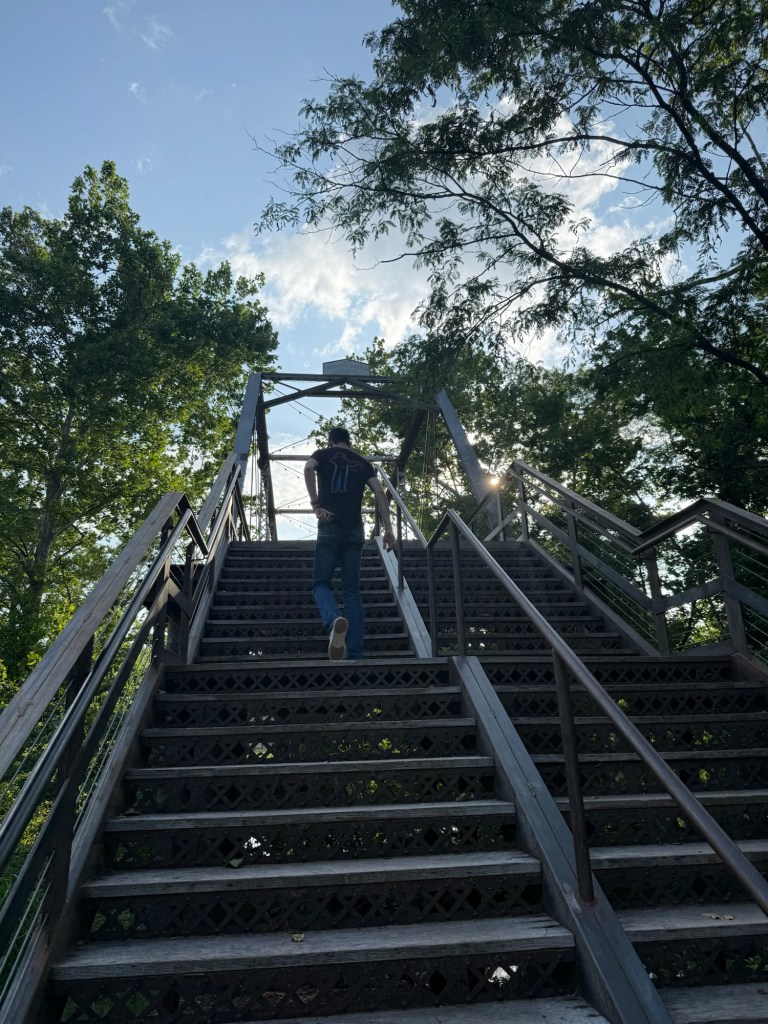
“Who shall ascend the hill of the LORD? And who shall stand in his holy place? He who has clean hands and a pure heart, who does not lift up his soul to what is false and does not swear deceitfully. He will receive blessing from the LORD and righteousness from the God of his salvation. Such is the generation of those who seek him, who seek the face of the God of Jacob.” (Psalm 24:3-6, ESV)
I would like to think my spiritual journey could accurately be depicted as a steady climb—pilgrim’s progress, pressing on, ever upward. Sadly, mine could more honestly be depicted as tempestuous noir sky disrupted by disparate sporadic flashes of light against the auditory backdrop of distant thunder, threatening to overpower everything within earshot. Chalk it up to poor choices or weak will, but my own timeline is less a straight line slanted upward and more like an EKG with high peaks and low valleys, with zig zags in between. Longingly, I have read accounts of individuals who climbed a mountain in their dreams, and that the dream represented confronting the challenges and obstacles that life presents. Each step symbolized a journey toward resilience building, teaching the importance of challenge acceptance.
While I admit to struggling with and often failing to gain such self-awareness and spiritual enlightenment during most of my ill-fated plummets, I have learned that overcoming obstacles isn’t primarily about reaching the summit; it’s about embracing and growing from the struggle along the way. Facing head-on our respective trials, you and I discover strength and adaptability we didn’t know was ours, realizing that every setback can be a stepping stone to strength and resilience. Self-discovery should lead to divine dependence. The best possible news is that we need not face our troubles alone; our Creator never intended victory to be won by pulling ourselves up by proverbial bootstraps, manning up, so-to-speak. We overcome by acknowledging inadequacy and crying out in desperate need for divine guidance and fortitude. We were designed for dependence—we need Him every moment of every day, and life surges forward when we discover and delight in His desire to sustain and empower us so that we never lose sight that we are His and He is everything to us.
My wife and I were both born in New Orleans and we grieve over the atrocity inflicted on innocent victims there. Our prayer is that in the midst of unspeakable sorrow, the God of all comfort will draw all to Himself.
My desire and commitment at the dawn of 2025 may be summarized with three words: return, refresh, renew. As I embark on my 65th year of life, I will to return to the hot-heart passion for Christ of my youth, pray for the refreshing wind of the Spirit to blow across and awaken every fiber of my being to my utmost for His highest, and determine to renew a sense of abandon to Christ and audacious adventurous faith in Him with whatever time left to me on this planet.
“The great word of Jesus to His disciples is Abandon. When God has brought us into the relationship of disciples, we have to venture on His word; trust entirely to Him and watch that when He brings us to the venture, we take it.”
(Oswald Chambers, ‘Studies in the Sermon on the Mount, The Complete Works of Oswald Chambers’)







 DANE FOWLKES