Outlive Yourself

“There is nothing to writing. All you do is sit down at a typewriter and bleed.”~Ernest Hemingway

Imagination budded as a child and written expression gave it wings to soar. I learned the comfort of words and the ecstasy of a reader’s admiration. Literary growth stalled in my youth as creativity succumbed to academic necessity. What began as an extension of myself muddled into stifling limitation, graded boxes that confined imagination. I place no blame for this on my teachers or curriculum, realizing the responsibility rested squarely on my shoulders. In college, I found new pleasure in research and academic writing, that in turn prepared me for fulfillment through sermon preparation. I rarely read from a manuscript when preaching, but preparation for oral expression comes primarily through written construction. Words are life.

In the late afternoon of life, I am discovering writing as calling; or perhaps I should say that writing is uncovering me. Instead of sudden insight, self-awareness more naturally unfolds like a quilt removed from cedar chest storage and unfurled into winter service. Personal exploration may be excruciating, but it is necessary preparation for higher expression. All that is to say that I write these days because I hope that my words with their moral and spiritual underpinnings will linger long after I’m gone. Find what it is that allows you to most fully be yourself, and express it in such a way that others may be altered by it. What we do in life should grow beyond our death. Each of us is called to outlive ourselves. 

Awakening and Shalom

“Once the soul awakens, the search begins and you can never go back.”~John O’Donohue

“But as for me, I am filled with power, with the Spirit of the Lord, and with justice and might.” Micah 3:8

On the surface it appears that Micah is boasting about the contrast between himself as prophet of God over against certain false prophets “who lead my people astray” (3:5). Perhaps Micah does feel a bit of righteous indignation at this point, but the purpose of his declaration is far afield from gloating. The prophet recognizes injustice in the land as an affront to Almighty God, and equates spiritual power with reclamation of justice. God rails against injustice and champions the downtrodden. Spirit-fullness is never self-centered or self-serving. Spiritual power on display always results in shalom; life becomes whole again for those broken by circumstance and conspiracy.

 
Awakening is solely the work of the Spirit. I can no more cause myself to be awakened than a raccoon can become a mountain lion. What I am charged with is surrender–that is solely my responsibility. While I cannot quicken my spirit to the Spirit of God, I can and must relinquish control to Sovereign Father. I stand in the way of my own deliverance. I dare not trust my emotions; they are far too fickle as to instill confidence at any level. I fling myself at the feet of One who hears me and knows tomorrow. He is best positioned to shape and use me for purposes higher than I would ever choose for myself; it is cruel to settle for the desires of my heart unless filtered through grace and divine intent. A hurting world awaits the outcome. 

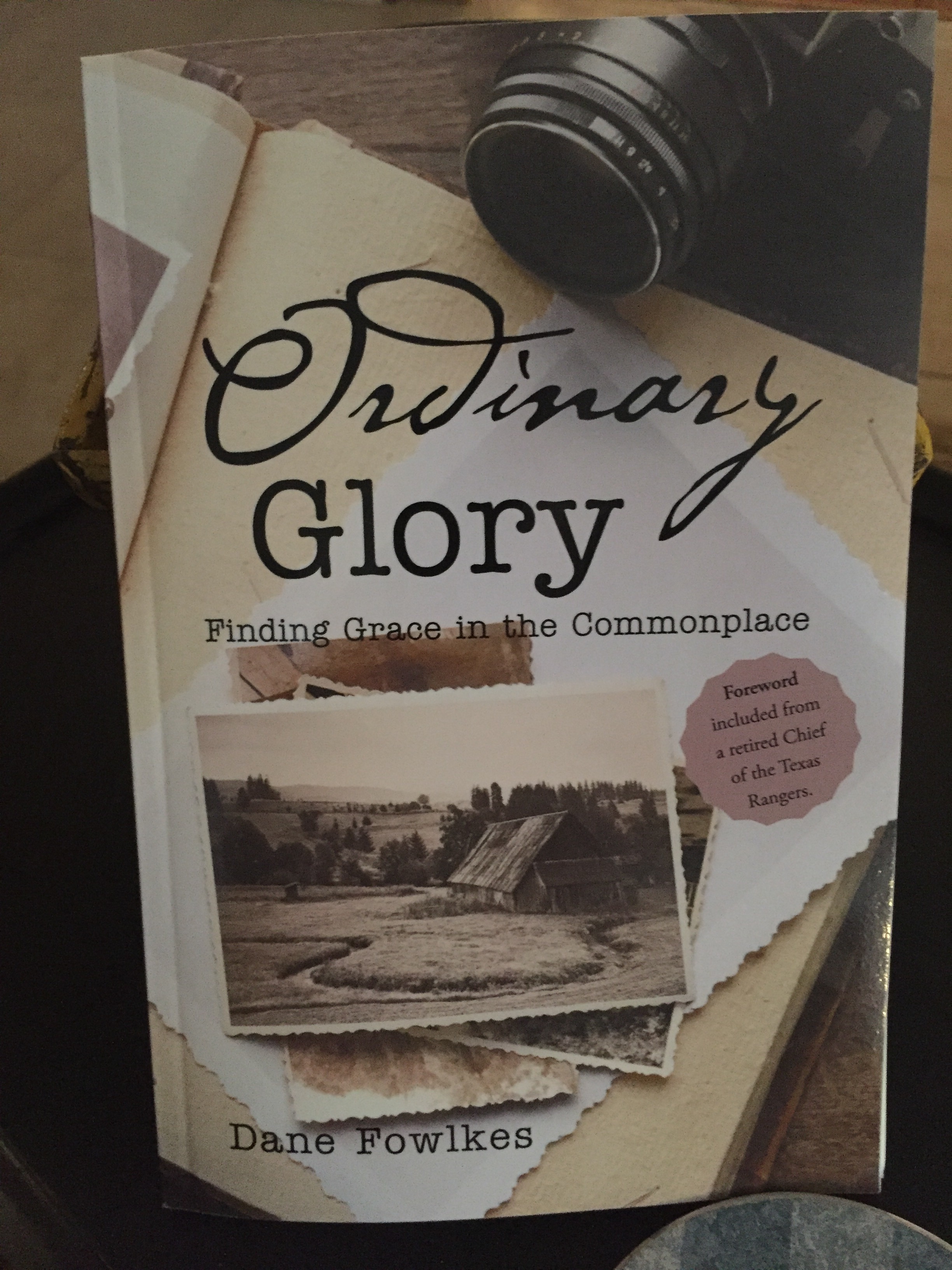
http://www.christianfaithpublishing.com/books/?book=ordinary-glory-finding-grace-in-the-commonplace

Michael

“Where love is, God is.” ~Henry Drummond

Just before moving to Kenya in my early 30’s, I was pastor of an all-Anglo congregation in a rapidly transitioning neighborhood. I proclaimed ad nauseam that the church should mirror its community, and we eventually made slow strides that direction. In attempt to set an example for others to follow, I made arrangements with a nearby low-income multi-family complex to hold a weekly evening Bible study in its small management office building. I advertised apartment-to-apartment and was pleasantly surprised by the turnout on our first night. It was a Heinz 57 gathering if I’ve ever witnessed one. The collective appearance of the twenty individuals that showed was so diverse as to be comical. One young man stood out from the others because I became acquainted with him best. 

Michael was a chain smoker who owned nothing but a pair of tattered jeans, an ochre stained white t-shirt, and a cigarette lighter. We struck up conversation, and Michael told me that he had been a heavy drug user and that he struggled at the simplest of tasks these days. I learned he was older than he looked behind the whispered and nicotine streaked face, and for reasons God only knew, he felt comfortable talking to me. I began visiting Michael regularly in order to encourage him, meet some of his basic needs, and share Christ along the way. We would converse in his smoke thick living space and then he would give me a hug, initially against my will, before making my escape and re-emerging into fresh air. After numerous such afternoon visits, Michael confided in me that he was gay. To be completely honest, I initially pulled away because such a lifestyle repulses me, but perhaps because I had become so well acquainted with him, I pushed beyond my impulse to run and continued the conversation. I am glad that I did. One afternoon several weeks later, Michael bowed his head along with mine and gave what remained of his life to Christ. I could not know at the time, and still am not fully aware of all that changed for Michael that day and the days that followed, but I can say what changed in me. I learned that it is possible to remain firm in biblical conviction against sin while lovingly leaning the sinner toward Christ. 

Believers in America are watching the culture march away from biblical morality with increasing speed. For instance, I read this week that the latest version of Beauty and the Beast has a gay scene between LeFou and Gaston. Disney just aired its first-ever gay cartoon kiss, and animators of Moana say they wouldn’t rule out an LGBT Disney princess in the future. While I abhor and actively oppose such perversion and blatant disregard for biblical morality, I will attempt to remember Michael, and refuse to jettison relationships that may be the only chance some have to see the Gospel for what God intended and not what Hollywood condemns. Thank God, Jesus loves indiscriminately, and I must take my cue from him. Rarely does anyone ever come to Christ without passing through a meaningful relationship with a disciple. Sharing Christ is always relational because we were created for relationship. For God’s sake, refuse to compromise biblical conviction for yourself or your family, but for Michael’s sake, allow yourself space to love indiscriminately as the highest imitation of our Lord.

Appreciation & Requests

I am extremely grateful for the many who have purchased and commented positively on Ordinary Glory. Thank you! As a result, I have two requests. First, will you consider posting a review of the book on either Amazon.com or barnesandnoble.com? Positive reviews encourage others to read. Finally, I would appreciate your sharing this post with your friends. Thank you for joining me in the effort to inform others about Ordinary Glory: Finding grace in the commonplace. And remember, “grace is always present tense.”

Contentment

“Many people lose the small joys in the hope for the big happiness.”~Pearl S. Buck

I am satisfied with my life. That may not strike as much of a confession, but it is the grandest expression of living I’ve ever known. While some may see in satisfaction a resignation, an acceptance that life will probably never get better-just glad it isn’t as bad as it once was, I see it as the highest possible enjoyment. No longer my own worst enemy, life has ceased turning in on itself. As the Apostle once remarked, “godliness with contentment is great gain.” To be satisfied is to be free from regret and unbothered by uncertainty, far removed from fatalistic acceptance and more akin to the secure confidence a child finds in a parent’s arms. I am not implying that nothing remains to be done or that I have no room for improvement–far from it. What I am stating is that contentment is a pleasant vantage point from which to embrace and enjoy all possible vistas.

Birthdays

“We are always the same age inside.” ~Gertrude Stein

I rolled in just after midnight following a late night class with graduate students who were eager to recover the biblical meaning of evangelism. After checking messages and emails, I remembered that I am now officially a year older and nearer my own curtain call than ever before. The term birthday seems obvious enough. The word comes from the Middle English byrthe, which may be related to the old Welsh word brith, meaning blemish or pimple. Now we’re getting somewhere. Modern definitions treat birthdays as the anniversary of the day on which a person was born, typically treated as an occasion for celebration and the giving of gifts. A more sober view is that it marks the day from which we start counting down to the end. 

A more elevated perspective on birthdays is to acknowledge them as another opportunity to breathe and hope and love. I do not know what today holds, and doubt that anyone ever really does; instead, I can speak of expectations. I expect to brew coffee and deliver a cup to my wife when she awakes before downing my own. I expect to complete work responsibilities on time, then change into boots and jeans and scoot off to a family birthday dinner where I will be the guest of honor. I expect we will return home, settle in for the duration in comfort clothes and with comfort food. I expect that I will fall asleep in my recliner on cue, pretend I did not to my wife, then rouse myself enough to take the dog out and collapse into bed. Those are the routines and choices I predict, but the day will also doubtless be replete with unexpected opportunities to detect the hand of God, to observe incarnation at work, to be the evidence to someone that God still walks among us, and that the Creator cares more than just a little. Rather than resigning to the inevitability of the end, I will embrace the beauty of each moment as a beginning.

What I’m Reading

“The man who does not read good books has no advantage over the man who cannot read them.” ~Mark Twain

“Always read something that will make you look good if you die in the middle of it.” ~P. J. O’Rourke

One of the categories of relationship I’ve enjoyed most through the years has been that of teacher and student. Most recently at Dallas Baptist University and East Texas Baptist University, those relationships stretch as far back as twenty three years ago at St. Paul’s United Theological College and later Kenya Baptist Theological College, each situated some fifty kilometers from Nairobi, Kenya. I love the stimulating exchange of ideas and occasional challenge to them. Most of all, I love the students themselves. Many of them from both continents stay in touch, and frequently put forth the same question I received almost daily when meeting them in the classroom: “Dr. Fowlkes, what are you reading?” Their inquiry has nothing to do with the day’s assigned reading for class; they want to know my literary preferences on a far more personal level.  

In keeping with that vein of thought, I’ve decided to share from time-to-time a short list of books that I’m currently speeding or slogging through. It is a rarity for me to complete one without having started multiple others, so my current reading list will likely always contain several titles. For the past twenty or so years I have attempted to follow a simple rule of thumb, that of reading roughly simultaneously one proven classic, another by a more contemporary author, and, finally, perusing reliable periodicals containing the most up-to-date coverage of ideas and events. Here is my current assortment accompanied by a few comments:

A Bend in the River, by V. S. Naipaul (Kindle edition). Published by Alfred A. Knopf, 1979.

– Naipaul is a Nobel prize winning author from Trinidad whose subject matter often confronts colonialism and its modern repercussions. He writes through his struggle with a mix of Trinidadian, Indian, and British roots. At times the result is somewhat comic. At other times the tone is rather bleak, but Naipaul’s works are always well written. 

The Nick Adams Stories, by Ernest Hemingway. Published by Scribner, 1969.

– Hemingway lines my shelves, and I rarely find myself without a volume close at hand. His terse writing style sweeps the reader along with his flawed characters through self-discovery, and, at times, self-loathing. All too often when reading Hemingway, I find myself staring back at me. 

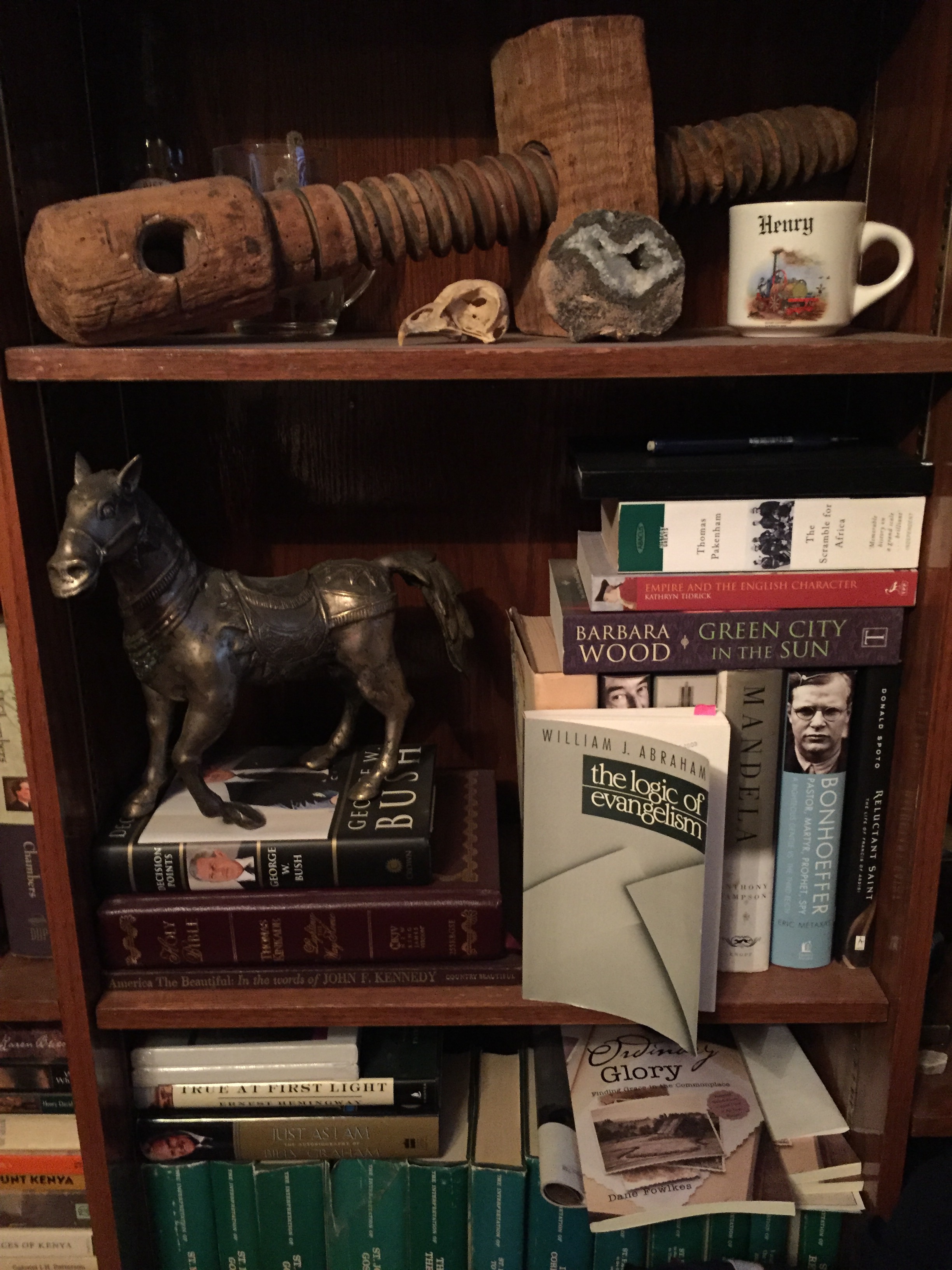
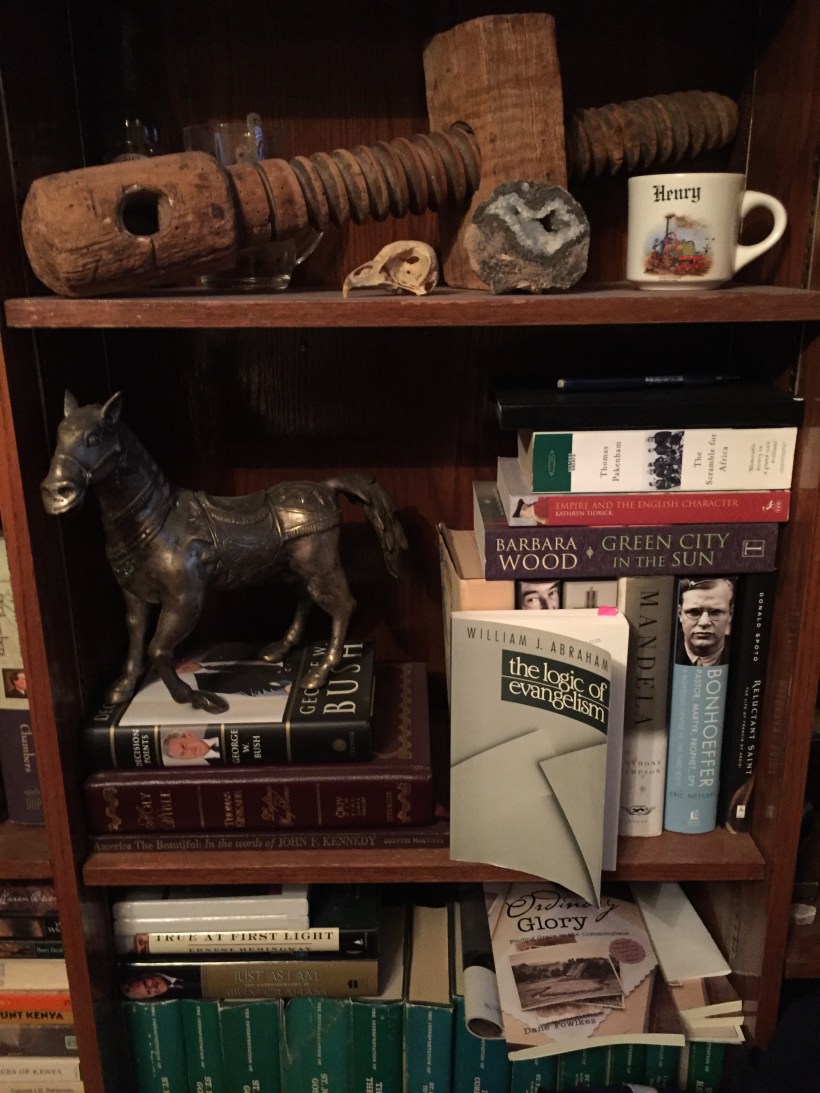
The Logic of Evangelism, by William J. Abraham. Published by William B. Eerdmans Publishing Company, 1989.

– Don’t let the publishing date deceive you; this is a classic. I heartily recommend this work to all those who enjoy thinking deeply about conversion, the Gospel, and disciple making. Today’s Church could use a fresh jolt from The Logic of Evangelism. 

Black Flags: The rise of Isis, by Joby Warrick. Published by Doubleday, 2015.

– In preparation for an upcoming journey to northern Iraq, I am attempting a bit of immersion into the history and mind of ISIS. This is a grim but gripping account of the crisis that weighs heavily on our world and lies all the more forebodingly on the horizon.

My Utmost: A devotional memoir, by Macy Halford. Published by Alfred A. Knopf, 2017.

– I have only just started this book, but according to the first few pages holds promise for a good read. My Utmost for His Highest has long been a favorite of mine, so I am enjoying reading about its impact through a fresh set of youthful eyes.

Valentine’s Day

Valentine’s Day is not a holiday to observe, but a sequence to savor. It is one moment to push pause among other quite ordinary moments and really see the other, and in the seeing learn something that changes yourself….

I met the best part of my life at a predetermined place and time. We planned to meet outside the Navarro County courthouse in Corsicana, having mutually agreed to eating lunch together at a neutral site so that either or both of us could make a graceful exit should the experience prove uncomfortable or unbearable. I arrived first, and sat in my pickup nervously waiting for her to pull up. When she did, even from a distance I could see that she was attractive, and her arrival in a sporty Acura RSX made me feel all the more awkward and out of place. I sat frozen to the stained bench seat of my old Ford while she waited for me to exit my truck and walk over to greet her. After what seemed an eternity to us both, I garnered enough courage to make my way to her open window. We exchanged greetings and I invited her to join me for lunch a few blocks away at Roy’s Cafe on Beaton Street. The date was off to a sluggish start, largely because I proved adept at all the wrong things. She chose healthy salad-something while I doused my chicken fried steak in ketchup, but for reasons known only to her she agreed to extend our date by walking together down Beaton and stepping into antique shops. To my surprise and utter delight, we kept finding reasons to prolong the experience, extending the date a full eight hours. What was even more unexpected was her willingness to see me again. We married six months later. The attraction is stronger now than ever because it has deepened into appreciation. I recognize the value of my wife and can honestly say that I see God’s grace in her eyes every morning…. This is not love defined by attraction; it is far more meaningful than that. It is appreciation, satisfaction, adoration, respect, friendship, astonishment and passion enough for a lifetime. Thank God I got out of the truck and said “hello.”
(Excerpts from Ordinary Glory: Finding Grace in the Commonplace, available at Amazon.com and barnesandnoble.com)

Thank You Mr. Buechner

I owe a great debt to a man I will likely never meet–Frederick Buechner is the single most significant influence on my writing. If I am able to be one-tenth of the author Buechner is, I will deem my writing a great success. You will find several Buechner quotes in my newly released book, Ordinary Glory: Finding Grace in the Commonplace. Thank you Mr. Buechner for your ongoing influence in many lives, including my own. 

Literary Wisdom

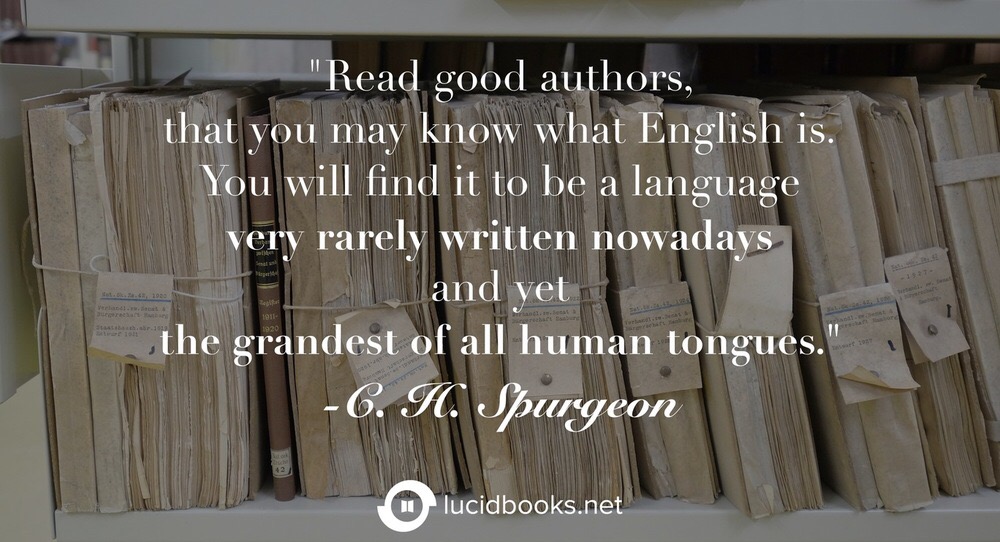
Literary inspiration from C. H. Spurgeon:

“Many of our hours of pain and weakness have been lightened by preparing the first volume of our book on the Psalms for the press. If we could not preach we could write, and we pray that this form of service may be accepted of the Lord” (Sword & Trowel, January 1870).