January 6

“When thou passest through the waters . . . they shall not overflow thee.” Isaiah 43:2

“God does not open paths for us in advance of our coming. He does not promise help before help is needed. He does not remove obstacles out of our way before we reach them. Yet when we are on the edge of our need, God’s hand is stretched out.” (Streams in the Desert)

God is always on time. Wounds do not negate God’s goodness, and scars are not evidence of a tardy deity who plays reckless with our lives. Father does know best, and insists upon it even if we call his intervention something else at the time.

“In the secular view, suffering is never seen as a meaningful part of life but only as an interruption.” ~ Tim Keller

A noticeable scar still protrudes above my left kneecap, although it is barely visible to the unknowing eye. I feel no pain from the wound because it healed over fifty years ago, but I remember the reason it is there–it signifies very little to others, but leaves an inescapable impression on me. Stated simply, I remember the reason for the wound. A seven-year-old cannot understand the intent underlying every parental injunction, and I was no exception to the rule. Mine warned me not to run down the narrow cement sidewalk bordered by a brick flower bed that led to our front door, especially when coastal humidity gathered on the concrete surface creating an ice-effect in the tropical climate. I refused to heed the warning, and instead turned it into a game when Mom and Dad were not looking. On one particularly balmy day, I failed to navigate the turn near the far end of the brick enclosure, jamming my knee into its jagged edge. The brick sliced deep, and the cut opened the shallow skin, exposing blood and tissue. Stitches would have helped, but we were not emergency room types. That was the last time I disobeyed my parents with regards to running on the sidewalk. Fifty years is a long time to heal, but I remember my misguided choice each time I bend and catch a glimpse of the unnaturally bunched skin on my knee. The pain is gone, but the warning remains.

No one can avoid scars. Scars serve a purpose; they teach by warning against replicating failure. There are things in my past I would love to forget, but choose to remember so as not to repeat them. I refuse to relinquish memory and forfeit the benefit of my wounds. Scars are defined as marks left on the skin or within body tissue where a wound, burn, or sore has not healed completely and fibrous connective tissue has developed, but they hold greater significance if they are blemishes from our past. It is not perfection, but healing that defines us.
January 5

“Lord there is none beside thee to help.” 2 Chronicles 14:11 I RV

“The odds against Asa were enormous. There was a million of men in arms against him, besides three hundred chariots. It seemed impossible to hold his own against that vast multitude. There were no allies who would come to help; his only hope, therefore, was in God. It may be that your difficulties have been allowed to come to so alarming a pitch that you may be compelled to renounce all creature aid, to which in lesser trials you have had recourse, and cast yourself back on your Almighty Friend.” (Streams in the Desert)

Agonizing circumstances brought about the birth of Streams. Excerpts from Mrs. Cowman’s 1924 diary written during the long months of her husband’s illness, unveil an inner sanctum of dark suffering in which God’s purposes are only dimly discerned. During their years together as missionaries, the Cowmans had firmly established a legacy of relentless passion for Christ. Oswald Chambers, who visited their work in Japan, said “The thing that strikes you about Charles Cowman is his absolute reckless, careless abandonment to Jesus Christ.” Not long after Chambers’ assessment, Charles was stricken with a severe heart attack that left him invalid until his death on September 25, 1924. It was through this crucible of testing that Lettie’s literary legacy was born. In Streams she writes as a survivor, and as such lends a helping hand to each of us on our own journey of despair and triumph. Lettie states in a personal preface to her collection of devotional writings:

“Both in the physical and spiritual realm, great pressure means great power! Although circumstances may bring us into the place of death, that need not spell disaster—for if we trust the Lord and wait patiently, that simply provides the occasion for the display of His almighty power.”

“When nothing whereon to lean remains,

When strongholds crumble to dust;

When nothing is sure but that God still reigns,

That is just the time to trust.

‘‘Tis better to walk by faith than sight,

In this path of yours and mine;

And the pitch-black night, when there’s no outer light

Is the time for faith to shine.” Streams

January 4

“Jesus saith unto him, Go thy way; thy son liveth. And the man believed the word that Jesus had spoken unto him, and he went his way.” John 4:50

“When ye pray believe.” Mark 11:24

“You will never learn faith in comfortable surroundings. God gives us the promises in a quiet hour; God seals our covenants with great and gracious words, then He steps back and waits to see how much we believe; then He lets the tempter come, and the test seems to contradict all that He has spoken. It is then that faith wins its crown. That is the time to look up through the storm, and among the trembling, frightened seamen cry, ‘I believe God that it shall be even as it was told me.’” (Streams in the Desert)

Prayer is more alignment than it is activity, and confidence must always be placed in a Person, never circumstance. Faith is longing that refuses to be satiated by lesser things. It is desiring the Father far more than our request from Him. Faithless prayer reeks of desperation; faith pries us from our doubts and secures us firmly in the grip the Master. All else relinquishes its hold on us; better still, we stop clinging to shadows. There is something defining about living with longing; we are created for eternity.

“Does it mean something? What is the truth of this interminable, sprawling story we all of us are? Or is it absurd to ask about the truth of it as it is to ask about the truth of the wind howling through a crack under the door?” (F. Buechner)

We may not be allowed much more than a glimpse under the door, but if we stoop low and small enough we feel the wind of another world whisper against our cheek and pull us upward. The challenge is balancing contentment, a fitting companion for godliness, with a longing for Someone more. Fortunately, it is entirely possible to be at peace with our here and now while restlessly straining for the Author of the journey that is just now underway. The true currency of this life spent in gracious acts and loving words is a mere down payment on the hereafter. Sanctify the moment by unearthing the glory in and around you, all the while steering your heart toward home.

January 3

“I will lead on softly, according as the cattle that goeth before me and the children be able to endure.” Genesis 33:14

“What a beautiful picture of Jacob’s thoughtfulness for the cattle and the children! He would not allow them to be overdriven even for one day. He would not lead on according to what a strong man like Esau could do and expected them to do, but only according to what they were able to endure. He knew exactly how far they could go in a day; and he made that his only consideration in arranging the marches. He had gone the same wilderness journey years before, and he knew all about its roughness and heat and length, by personal experience. And so he said, ‘I will lead on softly.’” (Streams in the Desert)

Huddling by candlelight is not necessarily romantic. My wife and I reclined on pillows in the dark hallway because Mother Nature was taking a howling swipe at us. Although definitely not the right setting for romance, it would have at least been peaceful were it not for our neurotic dog. Misha has been a member of our family for only a few months, but is already ensconced as a couch potato of the highest variety. My wife gave her to me on my 56th birthday, and we both marveled at the time at her ridiculously low price. Registered Rhodesian Ridgebacks normally sell for a thousand dollars or more, making Misha’s $100 price tag a mere pittance. Born six years ago, she has been used for breeding all her life and the story we were told is that her fifth and last pregnancy was brutal. None of the litter survived, so her breeders were looking for a home where she would be well cared for and loved. The three of us meshed almost immediately, but my wife and I have since gained a better understanding as to why Misha was not strong breeding stock.

Our first clue came during a deafening thunderstorm. Misha paced back and forth panting, then attempted to wedge her 72 pound frame into the two foot space behind my wife’s embroidery table. The second clue materialized as we watched Misha react in abject terror when she encountered our cats. Ailurophobia is not a desirable trait for Ridgebacks originally bred by Afrikaaners in Southern Africa for the purpose of hunting lions. Suffice to say that a breeding dam afraid of her own shadow and terrified of cats comes up short in the desired DNA department. Daughter of Simba and Nala, granddaughter of Sidboarani Ruffion Muskit Ridge, great granddaughter of Zyon King of Kalahari, Misha Kalahari is an adorable companion, but a lousy champion of canine ferocity.

The image of Misha cowering before our Siamese and Calico came to me the other day when I caught myself relinquishing hope in the shadow of inevitable battles. Created in the image of the Almighty and recreated by the resurrected King of Kings, how dare I bow beneath the weight of worry and fear? I concede the upper hand to doubt, debt, and ordinary demands, all of which are powerless to overcome He who has already overcome. A defeated believer is an oxymoron; Christianity was never intended as a defensive posture.

“All the world is full of suffering. It is also full of overcoming.” ~ Helen Keller

The great news about the Good News is that the battle is the Lord’s and we are on the winning side. Fulfill your birthright; advance under the banner of our victorious King. No matter where He leads, He has been there before and is more than able to “lead on softly” through the fog or fight, and bring you securely to the other side.

January 2

January 2

“And there was an enlarging, and a winding about still upward to the side chambers: for the winding about of the house went still upward round about the house: therefore the breadth of the house was still upward, and so increased from the lowest chamber to the highest by the midst.” Ezekiel 41:7 | KJV

“Not many of us are living at our best. We linger in the lowlands because we are afraid to climb the mountains. The steepness and ruggedness dismay us, and so we stay in the misty valleys and do not learn the mystery of the hills. We do not know what we lose in self-indulgence, what glory awaits us if only we had courage for the mountain climb, what blessedness we should find if we would move to the uplands of God.” (Streams in the Desert)

It is a good thing we don’t know the outcome before beginning; most wouldn’t have courage enough to initiate the climb. This life is anything but a cakewalk for the vast majority, meaning perseverance trumps giftedness. It is likely that the preacher had this in mind when he quipped:

“Again I saw that under the sun the race is not to the swift, nor the battle to the strong, nor bread to the wise, nor riches to the intelligent, nor favor to the skillful; but time and chance happen to them all” (Ecclesiastes 9:11 | NRSV).

The mystery of the hills is deciphered in the climb. While most enjoy occasional triumphs along the way, much of life is spent clambering upward through the mundane. As a younger man I eschewed anything that smacked of ordinariness; in my latter triad of life I am discovering that God rests in the people and experiences easily taken for granted. The everydayness of our existence will never enjoy good press, simply because it is so, for lack of a better word, common. You must grant yourself permission to discern grace in the commonplace. This is more than stopping to smell the roses. It is reveling in the rose’s glory and, more importantly, finding delight in its Creator who designed such beauty for our enjoyment. Make today an experiment that may change your life: Look hard to detect meaning in the most mundane aspects of your day, and then voice praise to your Heavenly Father for granting that moment or person or trial for your benefit. If Scripture is true in stating that God gives good gifts to his children, this day is replete with gifts waiting to be unwrapped by the discerning heart. In order to scale the summit, do yourself a favor as Brother Lawrence did, and practice the presence of God by establishing an altar in your heart that turns each moment into fuel for red hot passion for Holy God. In so doing, you will discover not only joy for the journey, but endurance needed to finish well.

“Too low they build who build beneath the stars.”

January 1

“. . . In the wilderness shall waters break out, and streams in the desert.” Isaiah 35:6

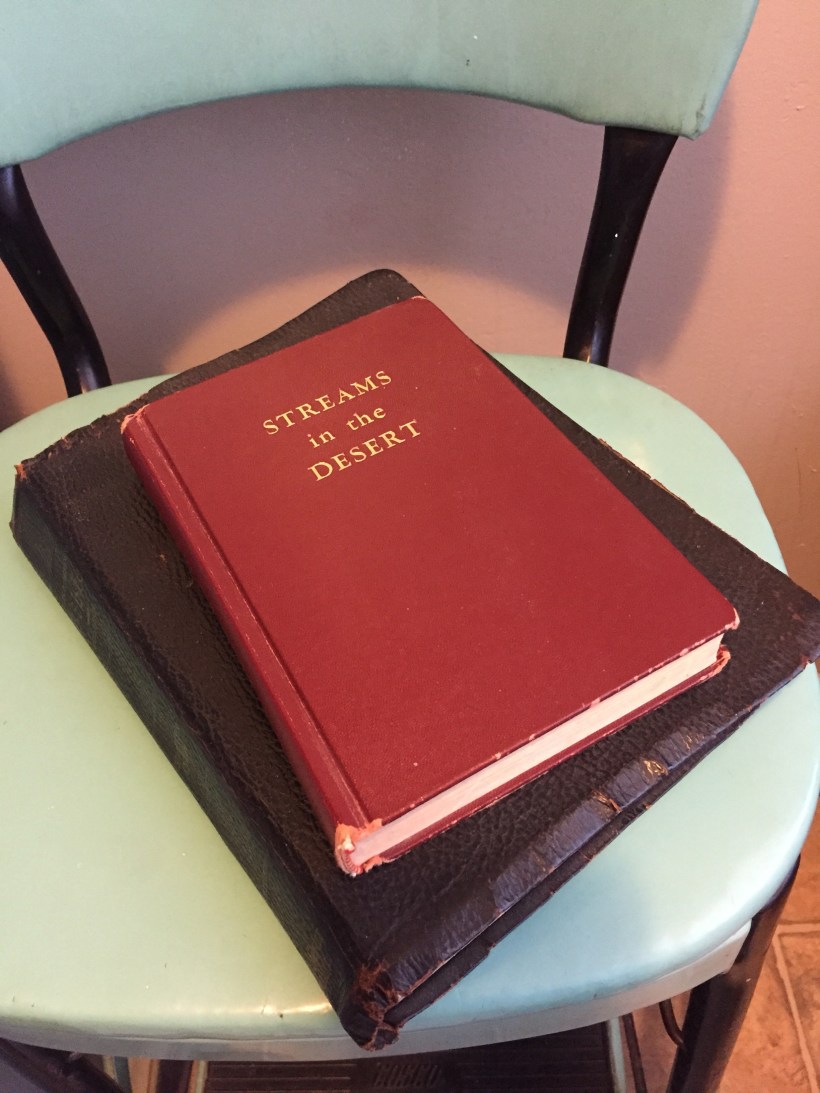
Inside the front cover is the handwritten note: “Christmas 1966, from Henry.” I now possess the small hardbound volume that my father gave Mother as a Christmas gift when I was six-years-old. That in and of itself is somewhat remarkable, but the more telling detail is from the moment Henry gave the book to Lois, it became her daily counselor and remained so until her death forty five years later. The volume rested usually atop a stack of telephone books that crested a turquoise vinyl covered metal step stool strategically located under the wall mounted telephone. At other times it lay on the corner of the kitchen table; but whether on the stool or tabletop, it always accompanied a dogeared leather Bible. In those early years, pyramids and camels adorned a glossy cover that protected its contents underneath. The dust jacket has long since gone the way of the camel caravan, but the clothbound volume remains. “Streams in the Desert” holds great importance for me because it served as Mom’s daily journal. She read a selection to begin each day, underscored a word now and then, and even added a handwritten note or date next to selected statements. I regain something of my mother as I read the scriptures, quotes, and author’s sentiments. Every entry opens up the past for me; I imagine what my mother thought and how she prayed as she considered that morning’s meditation. Lois Fowlkes put flesh and bone to the words written by missionary Lettie Cowman, and in so doing she became my own stream in the wilderness.

I am drawn to these devotions composed by one of my missionary heroes, primarily because they return me to the heart of my mother. For 2018, I have chosen to honor my mother’s daily practice and lasting legacy by selecting a portion of each day’s entry from “Streams in the Desert,” then adding my own thoughts to share with you. Along the way, I will include personal stories as well as tidbits concerning the author’s life. I invite you to join me for this journey through the past that leads to an enduring future.

“Today, dear friends, we stand upon the verge of the unknown. There lies before us the new year and we are going forth to possess it. Who can tell what we shall find? What new experiences, what changes shall come, what new needs shall arise? . . . All our supply is to come from the Lord. Here are springs that shall never run dry; here are fountains and springs that shall never be cut off. . . If He be the source of our mercies they can never fail us. No heat, no drought can parch that river, ‘the streams whereof make glad the city of God.’”

New Year’s Eve

“God pardons like a mother, who kisses the offense into everlasting forgiveness.” ~Henry Ward Beecher

New Year’s Eve can be the most excruciating day of the year for me. Forced to access performance professionally, I carry the spirit of evaluation into more personal areas, more-often-than-not a painful exercise. Finding it difficult to confine appraisal to the immediate year; thoughts frequently drift back over a lifetime, and herein lies the rub. It is far easier to lament failure than to celebrate progress. Disappointment looms large when moping over a big picture that encompasses missed opportunity, impotent decision making, intentional disobedience, and insufficient courage. Shadow boxing with the worst of me; I end up with a brown study of life with little reason to look up. Cruel truth is often convince myself I have failed at everything I’ve ever attempted; disappointment threatens to debilitate.

Thankfully, my grandson reminded me last night of what is so amazing about grace. He and my granddaughter were on the floor competing to construct the best track arrangement for a battery powered car manufactured to navigate the track. He tended to opt for steep inclines that prevented the car from making it over the top and around the course. Invariably, his car reached the same spot only to topple over and off the track. I waited for him to meltdown, an emotional throwing-in-the-towel, but he surprised me. Instead of quitting the contest, he said that he learns something every time the car falls off the track and adjusts the course accordingly. He said, “The chance to get better keeps me from giving up.” Deep truth from an eight-year-old—if only I can embrace the same. “Forgiveness is the giving, and so the receiving, of life” (George McDonald). We are not created to live in reverse. Our bodies face forward; our lives should as well. Each of us have reason to occasionally crane our head around to look behind, but the greater portion of our time is spent scanning what lies ahead. The horizon spreads before us, not abaft. Our past is forgiven and our future guaranteed.

“Beloved, I do not consider that I have made it my own; but this one thing I do: forgetting what lies behind and straining forward to what lies ahead, I press on toward the goal for the prize of the heavenly call of God in Christ Jesus.”

(Philippians 3:13-14 | NRSV)

A Personal Christmas Greeting

May this Christmas be for you and your family a rediscovery of sorts in light of an humble stable and simple manger. There has never been more ordinary Glory than the common birth of Jesus the Christ, King of kings and Lord of lords. “Christmas itself is by grace” (Buechner, “Whistling in the Dark”). As you press a seasonal pause on routine and carve out space from the rat race, gift yourself with honest reflection and ask the Lord of Glory to enable you to discern grace in your commonplace. On this holy day, I want to thank you for taking time to read these brief offerings that I pray serve to help you detect the face of God through the seemingly unremarkable moments that crowd our days. As I write, I also pray for those who will read my thoughts, and ask the Father to awaken each reader or at least alert them to what He is doing in and around them. Thank you for sharing this journey with me. May your Christmas Day be filled with glory!

Dane Fowlkes

Bosqueville

Home at Christmas

“Winter is the time for comfort, for good food and warmth, for the touch of a friendly hand and for a talk beside the fire: it is the time for home.” ~Edith Sitwell

Christmas is unapologetically about leaving home and finding it again. Mary left home to be with Joseph. Mary and Joseph left home to comply with tax law and gained a baby to boot. Their infant was birthed in an unfamiliar barn and wrapped in second-hand swaddling clothes. The burgeoning family was forced to stay away from home due to Herod’s bloodlust, but the trio returned eventually to Nazareth where Jesus matured at home in relative obscurity. He evidently lost his father along the way; the Gospels make no mention of Jospeh beyond Jesus’ bar mitzvah. Entering his third decade, Jesus left mother and siblings behind and assumed an itinerant ministry, choosing not to put down roots. “And Jesus said to him, “Foxes have holes, and birds of the air have nests, but the Son of Man has nowhere to lay his head” (Matthew 8:20, ESV). Along the way, Mary, Martha and Lazarus formed a surrogate home of sorts, but three short years into his ministry Jesus was abandoned by friends, murdered in a strange city by an estranged people, and placed in a borrowed tomb. A few days later that seemed like an eternity he was finally home again with Father.

Home always was and always will be defined by the ones who know you deeply and value you despite the truth they discover about you. “I live in my own little world. But it’s OK, they know me here” (Lauren Myracle). Home for me as a boy growing up in Port Arthur was Mother. I do not say that to take anything away from Dad, but Momma held time and space together for our family with Herculean strength. She still does even though she has been gone from us more than five years. Home was wherever Mom was, especially when she was on duty in the church library or at the Bible Book Shoppe where she worked to help make ends meet. I relate to what Elizabeth Kostova writes: “It was good to walk into a library again; it smelled like home.” I took home for granted as a child, but went in search of it again as a young man when I went away to college. Unfortunately, I lost my way choosing the wrong road back. I eventually came to my senses in a distant land, only to realize that home was somewhere I didn’t belong. “How often have I lain beneath rain on a strange roof, thinking of home” (William Faulkner).

Credit divine intervention and a good woman with helping me find home again. I cling to it now like a drowning man clutching driftwood to preserve his head above water. Whoever opined familiarity as contemptible didn’t know beans from parched coffee about what it means to return home. Whether returning home from a business trip, vacation, or long endured emotional void—the result is the same: in a word, contentment; in two words, safe place. “The ache for home lives in all of us. The safe place where we can go as we are and not be questioned” (Maya Angelou, All God’s Children Need Traveling Shoes). Christmas reminds us that God did the unthinkable so we may return home and stay put. “Perhaps home is not a place but simply an irrevocable condition” (James Baldwin). Blessed is the individual who finds unconditional love in the Father who declares us home with every embrace. Christmas declares with resounding voice, “You can go home again.”

An Impatient Gift

“Forever is composed of nows.” ~ Emily Dickinson

Ecstasy occasionally slips up on me. This is one of those moments. Shadows tinted by dawn leave the impression of frost spread across the room. Five minutes before it was black as pitch and five minutes later the magic will disappear. Competing winds outside whitewashed farm walls force stricken rust and sienna Red Oak leaves into spirals against their will, rising and falling with northern currents heralding impending change, but silence inside descends and expands until filling all available space. Aroma of wood ash from the fireplace somehow smacks of stale tobacco laced with vanilla, guaranteeing an olfactory memory. I may embrace the magic, or allow it to slip away never to return—the choice is mine. Life is sacred, but solitude is an impatient gift.

Courage to embrace the moment is rare. Most rush away mentally headlong in multiple directions, hellbent on thinking of anything and everything save here and now. We are all either running away from something or running toward someone; some of us are doing both at the selfsame time. Quiet and contemplation are an invitation to holiness, but otherworldly fortitude is required to stay the mental and spiritual course through conflict, chaos, boredom, and routine. Much of life is endured in the shadow of cliche’. Brother Lawrence lived out the secret while washing dishes in a monastery. Frank Laubach experimented with “practicing the presence” as a missionary in the Philippines. Henri Nouwen gleaned it from an anonymous Russian pilgrim: “Lord Jesus Christ, son of the living God, have mercy on me a sinner.” Buechner captures the essential conflict: “The temptation is always to reduce life to size. A bowl of cherries. A rat race. Amino acids. Even to call it a mystery smacks of reductionism. It is the mystery… After lecturing learnedly on miracles, a great theologian was asked to give a specific example of one. ‘There is only one miracle,’ he answered. ‘It is life.’” Contentment demands discipline. Train yourself to embrace mystery and you will marvel at the glory in the ordinary. Open your heart and see for yourself that Heaven is not so distant after all.