Mystery

“Forever is composed of nows.” ~ Emily Dickinson

Ecstasy occasionally slips up on me. This is one of those moments. Shadows tinted by dawn leave the impression of frost spread across the room. Five minutes before it was black as pitch and five minutes later the magic will disappear. Competing winds outside whitewashed farm walls force stricken rust and sienna Red Oak leaves into spirals against their will, rising and falling with northern currents heralding impending change, but silence inside descends and expands until filling all available space. Aroma of wood ash from the fireplace somehow smacks of stale tobacco laced with vanilla, guaranteeing an olfactory memory. I may embrace the magic, or allow it to slip away never to return—the choice is mine. Life is sacred, but solitude is an impatient gift.

Courage to embrace the moment is rare. Most rush away mentally headlong in multiple directions, hellbent on thinking of anything and everything save here and now. We are all either running away from something or running toward someone; some of us are doing both at the selfsame time. Quiet and contemplation are an invitation to holiness, but otherworldly fortitude is required to stay the mental and spiritual course through conflict, chaos, boredom, and routine. Much of life is endured in the shadow of cliche’. Brother Lawrence lived out the secret while washing dishes in a monastery. Frank Laubach experimented with “practicing the presence” as a missionary in the Philippines. Henri Nouwen gleaned it from an anonymous Russian pilgrim: “Lord Jesus Christ, son of the living God, have mercy on me a sinner.” Buechner captures the essential conflict: “The temptation is always to reduce life to size. A bowl of cherries. A rat race. Amino acids. Even to call it a mystery smacks of reductionism. It is the mystery… After lecturing learnedly on miracles, a great theologian was asked to give a specific example of one. ‘There is only one miracle,’ he answered. ‘It is life.’”

Contentment demands discipline. Train yourself to embrace mystery and you will marvel at the glory in the ordinary. Open your heart and see for yourself that Heaven is not so distant after all.

Going Home for Christmas

Christmas is unapologetically about leaving home and finding it again. Mary left home to be with Joseph. Mary and Joseph left home to comply with tax law and gained a baby to boot. Their infant was birthed in an unfamiliar barn and wrapped in second-hand swaddling clothes. The burgeoning family was forced to stay away from home due to Herod’s bloodlust, but the trio returned eventually to Nazareth where Jesus matured at home in relative obscurity. He evidently lost his father along the way; the Gospels make no mention of Jospeh beyond Jesus’ bar mitzvah. Entering his third decade, Jesus left mother and siblings behind and assumed an itinerant ministry, choosing not to put down roots. “And Jesus said to him, “Foxes have holes, and birds of the air have nests, but the Son of Man has nowhere to lay his head” (Matthew 8:20, ESV). Along the way, Mary, Martha and Lazarus formed a surrogate home of sorts, but three short years into his ministry Jesus was abandoned by friends, murdered in a strange city by an estranged people, and placed in a borrowed tomb. A few days later that seemed like an eternity he was finally home again with Father.

Home always was and always will be defined by the ones who know you deeply and value you despite the truth they discover about you. “I live in my own little world. But it’s OK, they know me here” (Lauren Myracle). Home for me as a boy growing up in Port Arthur was Mother. I do not say that to take anything away from Dad, but Momma held time and space together for our family with Herculean strength. She still does even though she has been gone from us more than eight years. Home was wherever Mom was, especially when she was on duty in the church library, or at the Bible Book Shoppe where she worked to help make ends meet. I think of her every day, especially when I enter a frequent haunt—the library. “It was good to walk into a library again; it smelled like home” (Elizabeth Kostova). I took home for granted as a child, but went in search of it again as a young man when I went away to college. Unfortunately, I lost my way choosing the wrong road back; I eventually came to my senses in a distant land, only to realize that home was somewhere I didn’t belong. “How often have I lain beneath rain on a strange roof, thinking of home” (William Faulkner).

Credit divine intervention and a good woman with helping me find home again. I cling to it now like a drowning man clutching driftwood to keep his head above water. Whoever opined familiarity as contemptible didn’t know beans from parched coffee about what it means to return home. Whether returning home from a business trip, vacation, or long endured emotional void—the result is the same: in a word, contentment; in two words, safe place. “The ache for home lives in all of us. The safe place where we can go as we are and not be questioned” (Maya Angelou, All God’s Children Need Traveling Shoes). Christmas reminds us that God did the unthinkable so we may return home and stay put. The Father takes us as we are and declares we are home with each unconditional embrace. Christmas declares with resounding voice, “You can go home again.”

Christmas Eve

Christmas is a high and holy day for every Christ follower, but I confess that the evening before holds special meaning to me. Our family tradition is to gather in our home for a meal and gift-giving before heading off to church together for candlelit worship. The gifts are under our tree for a reason, each carefully chosen to give shape to the unseen bond that connects our hearts year ‘round. More than once tonight my eyes will moisten and I’ll be forced to turn away to prevent embarrassing myself. It could be due to my advancing years, but something moves me in my deepest unexplored parts when a child I love erupts in gleeful surprise as she or he discovers what lies beneath the colorful tissue and glitter laden ribbons. I enjoying witnessing those I love entranced and exuberant without restraint, but something transpires within me as well that I welcome like water to a desert-bound wanderer. In a few moments that honestly pass far too quickly to take it all in, I flashback to innocence and new beginnings feel within reach once again. Christmas is for children; we are celebrating the Christ-child, after all. The beautiful thing is that in the anticipation of the holy day, I return to childlike innocence and find it possible to once again believe that God may just enact a miracle within me as well as in the manger.

“It is impossible to conceive how different things would have turned out if that birth had not happened whenever, wherever, however it did … for millions of people who have lived since, the birth of Jesus made possible not just a new way of understanding life but a new way of living it. It is a truth that, for twenty centuries, there have been untold numbers of men and women who, in untold numbers of ways, have been so grasped by the child who was born, so caught up in the message he taught and the life he lived, that they have found themselves profoundly changed by their relationship with him” (Frederick Buechner).

Christmas Grace

“And she gave birth to her firstborn son and wrapped him in swaddling cloths and laid him in a manger, because there was no place for them in the inn” (Luke 2:7 | ESV)

I look forward each year to the Sunday before Christmas because my wife and I attend a daughter’s church to watch our grandchildren in their annual Christmas program. To be completely honest, I endure the beginning of worship because the congregation stands an eternity and sings upbeat choruses unfamiliar to me that require syncopated rhythm completely foreign to me (I will always be more at home with hymn book than overhead projector). The reason we go and the moment I nervously anticipate is when the children attack the stage, scale the risers, and open their hearts to sing. The songs vary little from year-to-year as theirs is not a large church, and the children’s program is anything but expansive. But I have witnessed growth over the years in my young name’s sake, and eagerly await still another step in the right direction. I sit enthralled as Joshua Dane takes center stage, closes his eyes, sways to the beat, and belts out whatever he has been asked to sing. Label it pride if you must, but I call it grace. I was grafted into this family as an adult, and was called ‘Papa Dane’ initially out of politeness because no one really knew what to think about or what to do with a step-grandfather. My wife’s family bestowed an unfamiliar and undeserved title that reminds each time I hear it that God’s greatest gifts are the ones we could never obtain on our own.

Christmas may be this world’s clearest window on grace. The most profound reminder of the manger is that I cannot save myself, regardless of how I might attempt to convince myself otherwise. I need outside intervention of the most unfathomable kind. Grace is no longer a convenient theological topic to consider in a sermon or Bible study; it has become the life preserver to which I cling as though my life depends upon it—because it does. Left to myself I stumble blindly about, leaving an ugly trail of broken relationships. Left to God, He grants a new name and establishes an unmerited forever relationship. Christmas grace turns everything right-side-up, and leaves me to marvel that the Christ-child grafts me into his family and bestows a new name—child of God.

“See to it that you do not treat the gospel only as history, for that is only transient; neither regard it only as an example, for it is of no value without faith. Rather, see to it that you make this birth your own and that Christ be born in you.…Of what benefit would it be to me if Christ had been born a thousand times, and it would daily be sung into my ears in a most lovely manner, if I were never to hear that he was born for me and was to be my very own?” (Martin Luther)

Blue Christmas

Elvis may have popularized the notion of a “Blue Christmas,” but it is an actual day during Advent that marks the winter solstice, the longest night of the year that falls on or about December 21st. Some churches hold a service of worship that recognizes the holidays are sometimes “blue” or riddled with remorse and disturbing emotions associated with painful life events such as death, disease, poverty, or abuse. Not everyone is brimming with cheer and good will for the holidays. There is a positive trend toward growing attentiveness to the needs of people who are blue at Christmas and granting sacred space for people living through dark times, but how do you respond during the holidays when you are the target of someone else’s emotional assault? Is it even possible to experience healing and hope when circumstances conspire to rob your joy against the backdrop of this special time of year?

Sadly, holiday grief is often inflicted by those who are closest to us. There is no sting quite like that of a wound inflicted by a family member, especially when you are blindsided during the holidays. Et tu, Brute? Relational stabbing plunges deeper than other wounds because family is supposed to be safe space, one’s very own God-ordained support group. The holidays get ugly when a family member turns, leaving a war of emotion that feels anything but festive in its wake. You may be at fault or merely an innocent victim; the hurt is the same. I am attempting to follow my own advice, and you may benefit from applying one or more of the following to re-color and reclaim your otherwise “Blue” Christmas:

1. Examine yourself and the hurtful relationship honestly. Confess fault, but don’t accept blame that isn’t yours. More than anything, do not self-inflict shame. God convicts; Satan doles out shame.

2. Recognize what is out of your control, and relinquish the hurt along with the outcome to the Spirit of God.

3. Refuse to allow bitterness to take root (Hebrews 12:15).

4. Return to white-hot devotion to the Lord Jesus Christ. The unmistakable and fool-proof remedy for a Blue Christmas is unadulterated adoration of the Christ child, Almighty God incarnate, the Holy Eternal One wrapped in swaddling cloths and lying in a manger. O come let us adore Him.

“Father, forgive us our trespasses, as we forgive those who trespass against us. And lead us not into temptation, but deliver us from evil. For thine is the kingdom, the power, and the glory forever. Amen.”

Walden Pond

“Things do not change; we change.” ~ Henry David Thoreau

Most folks around this part of the world would call it a “tank.” I prefer to refer to it as Walden Pond (you’re welcome Henry David Thoreau). I enjoy hanging out nearby this time of year in particular because the autumn wind and chill combine to purge the organic clutter that tends to accumulate and obscure what resides beneath much of the time. We positioned a park bench about ten feet from the pond’s northerly edge, putting winter wind at our backs and fashioning a comfortable perch from which to dream, doubt, hope, hurt, confess, recover, resolve—all of which are synonyms for “pray.” Grandchildren grace the edges of Walden Pond in Spring with fishing poles and rods & reels in hand. Father-son, father-daughter, mother-child, and grandparent-grandchild dynamics serendipitously unfurl before the waiting bass and catfish. No subject is off-limits, and nothing prevents life-lessons from rolling off the tongue and into hearts. I have stood near the red and purples irises that parole the perimeter, and spoken of Jesus, heaven, Africa, church, baseball, guns, honesty, forgiveness, and only heaven-remembers-what-all-else. Turtles line-up at attention on a fallen log, blue herons frequent the shallows in search of choice morsels, kingfishers chatter across its surface, willows bend and sweep its edges according to the wind’s demand. Real life happens on and near Walden Pond, and it reminds me that life changes normally occur gradually midst the unnoticed and ordinary, rather than the startling and terrifying. The secret to growth lies in recognizing grace in the commonplace, and tuning-in to God’s still small voice that is seldom detected above the incessant din of calendar and clock. Everyone has a Walden Pond, although it may masquerade as your garage, living room, backyard, kitchen, or any other location where you laugh and cry, suffer and heal. Growth awaits you there. Clear the clutter, honestly assess your heart, and grant your Father space and time to draw you near. You will never be the same.

Aim Higher in Thanksgiving

“We only learn to behave ourselves in the presence of God.” ~ C. S. Lewis

Beware of gratitude born of comparison. Aim higher in thanksgiving. Apart from extraordinary spiritual vigilance, I fall into the trap of thanking God for what I have in contrast to what I don’t have or what I am not experiencing at the moment. I am thankful for my health over against sickness, for comfort rather than suffering, for fortunate circumstance instead of life spiraling out of control. Thank You, God, that I’m not ….. Although tip-toeing the borders of being self-serving, subjective thanksgiving is not necessarily wrong or harmful, simply short-sighted. Objective gratitude, on the other hand, sees the present through the lens of eternity, and moves beyond recognizing momentary benefit to heralding enduring value. Penultimate thanksgiving ascribes worth to individuals we value. For example, I am thankful for my wife because she has a pure heart and embodies all the qualities I deem exemplary in a woman. Ultimate thanks giving turns heavenward, and has as its result, worship. True gratitude grants vocabulary to adoration. I am grateful to our all-knowing, all-powerful, all-loving Father because He is holy and perfect and just and gracious and righteous, and…. His mercy is endless and He loves me with a love indescribable, ruthless, unrelenting; therefore, I thank Him first for who He is, and then express holy appreciation for all He has done and continues to enact for His renown.

Honest Fear

“What we hunger for perhaps more than anything else is to be known in our full humanness, and yet that is often just what we also fear more than anything else.” ~ Frederick Buechner

Contradiction is always puzzling, and at times downright troubling. One such apparent confutation arises in Holy Scripture. In one New Testament verse we are told: “Perfect love casts out fear” (1 John 4:18). A different Old Testament passage allows: “What time I am afraid, I will trust in God” (Psalm 56:3). One is a declaration that fear flees the presence of Perfect Love. The second honestly owns up to fear, then looks confidently outside itself for comfort. So, which should be true for the Christ-follower? My answer, if you could hear it audibly, would issue forth in something of a harassed whisper: “Both.” Clearly, we are not re-created to slink along in paranoia, riddled by doubts and threats, both foreign and domestic. Our Merciful Father intends to drive fear from us in the wake of ridiculous love. The prerequisite is relentless honesty.

Fear is a ruthless task master. The most damning aspects are those that remain hidden; in other words, the unfaced demons that lurk in the shadows pulling us down toward cowardice and paralysis. I must confess I deal with my own demons, unrequited phobias couched in questions such as: “Will I be remembered as a man of ideas, but void of substance?” “Am I wasting what little time I have left?” “Do I ever measure up?” Shadows haunt the past, mists fog the future. The greatest gift I can offer myself is honest admission. Unidentified and unanswered fear prevents us from being fully present, from embracing grace here and now. Doubt is not my enemy; dishonesty destroys mercy. Fear halts our dancing and insists on a limp. Honest recognition releases miracles; confession effuses divine love. Prepare right now for love unfettered by identifying fear by name and owning your pain, then surrendering it all to Almighty God, who is, by the way, Love.

Love divine, all loves excelling,

Joy of heaven to earth come down,

Fix in us thy humble dwelling,

All thy faithful mercies crown.

Jesu, thou art all compassion,

Pure, unbounded love thou art;

Visit us with thy salvation,

Enter every trembling heart.

Breathe, O breathe thy loving Spirit

Into every troubled breast,

Let us all in thee inherit,

Let us find that second rest.

Take away the love of sinning,

Alpha and Omega be;

End of faith, as its beginning,

Sets our hearts at liberty.

Come almighty to deliver,

Let us all thy life receive;

Suddenly return and never,

Never more thy temples leave.

Thee we would be always blessing,

Serve thee as thy hosts above,

Pray, and praise thee without ceasing,

Glory in thy perfect love.

Finish then thy new creation,

Pure and spotless let us be;

Let us see thy great salvation,

Perfectly restored in thee;

Changed from glory into glory,

Till in heaven we take our place,

Till we cast our crowns before thee,

Lost in wonder, love and Praise.

(Charles Wesley)

Unexpected Book Signing

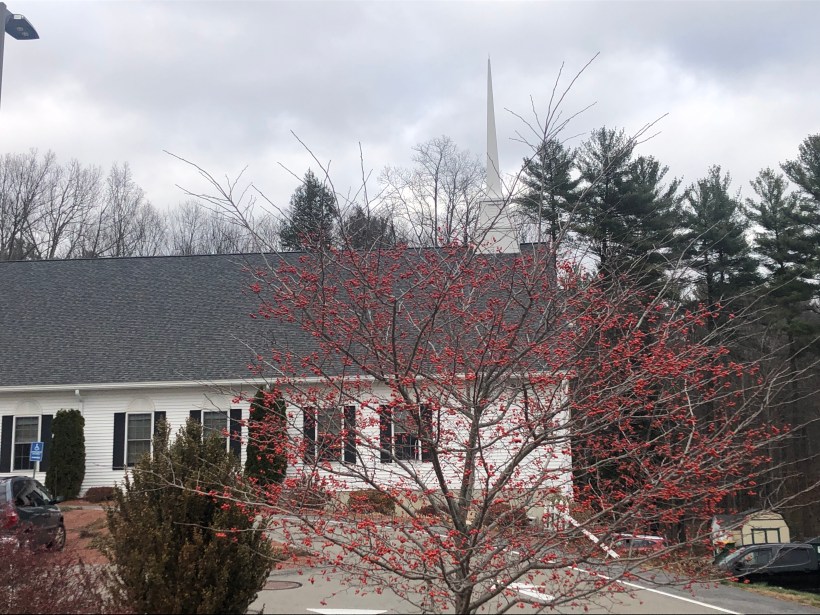
Yesterday was a first for me. I am accustomed to guest speaking for churches, and always enjoy the opportunity to meet new folks and speak into their lives, if only for a moment. There was every reason to expect Sunday morning to fall right into line with all those others before, but this time was different. To my utter amazement, my wife and I entered the narthex and found a table containing my book, “Ordinary Glory.” Pastor McBride had taken it upon himself to purchase copies of the book and inform his congregation that I was writer as well as preacher. A short while later—just before morning worship began, a gentleman came to where my wife and I were seated and asked me to autograph a copy for their church library. It was humbling and a bit surreal, to say the least. I am grateful to Dr. McBride and the sweet fellowship of Raymond Baptist Church in Raymond, New Hampshire for their thoughtfulness and gracious reception.

Dawn

Dawn is a brief invitation to hope. In moments gradually bathed in translucence, past regrets recede replaced by possibilities. The aged prophet must have had something similar in mind when he penned, “The steadfast love of the Lord never ceases; his mercies never come to an end; they are new every morning; great is your faithfulness” Lamentations 3:22-23 | ESV. I wrestle far too frequently with evening remorse; I need the sun to rise. I cling to the promise of inspired writ that what matters about me most can be rebooted each morning irregardless of what argument my memory and body makes to the contrary. Our God is the God of new beginnings. I prefer sunrise to sunset; I choose hope.

“So we do not lose heart. Though our outer self is wasting away, our inner self is being renewed day by day. For this light momentary affliction is preparing for us an eternal weight of glory beyond all comparison, as we look not to the things that are seen but to the things that are unseen. For the things that are seen are transient, but the things that are unseen are eternal.” 2 Corinthians 4:16-18 | ESV