Martyr or Misguided Adventurer?

Father, make of me a crisis man. Bring those I contact to decision. Let me not be a milepost on a single road; make me a fork, that men must turn one way or another on facing Christ in me. ~Jim Elliot

The most important story of the week is one you likely have not heard. John Allen Chau was shot with bows and arrows as he landed on North Sentinel island of India’s Andaman and Nicobar Islands, a remote location forbidden to outsiders. According to local officials, the 27-year-old was a Christian missionary. Officials say the islanders have lived in isolation for nearly 60,000 years and advocacy group Survival International said that by contacting the community, Chau may have passed along pathogens that have the “potential to wipeout the entire tribe” of about 50 to 150 people.

Chau described himself as “a snakebite survivor” and wilderness medic who is “following the way”. He said he was inspired by the Victorian explorer and missionary David Livingston, and Jesus. A missionary who was in contact with Mr. Chau in the last days of his trip says his aim was to bring the gospel to the island’s tribesmen. In a last note to his family, Chau wrote: “You guys might think I’m crazy in all this but I think it’s worthwhile to declare Jesus to these people.” He added that he was “doing this to establish the kingdom of Jesus on the island… Do not blame the natives if I am killed.”

Jeff King, president of International Christian Concern, the organization with which Chau was aligned, was in contact with him during his visit:

“John went there to bring the gospel to these people… He had talked about it… planned it for a while, so it wasn’t a whim, it wasn’t a lark…. He’d been in the islands before, to this particular island… there were three or four visits on that day, and what happened was on the first visit he was turned back by arrows; the second visit, he came with two big fish as a gift. My understanding was the men accepted the gift; they sat together for an hour; he said they were menacing and they actually shot him. He went back to the boat, and then gradually went back a third time. That’s when the fishermen who were looking through binoculars saw that they’d killed him and were taking him apart. This was not a job he was doing—this was a dream he had that unfortunately went wrong.”

John Allen Chau was an adventurous young man with a passion for Christ and commitment to spread the Gospel. He was not a trained missionary, and we could easily criticize what went wrong; instead, I prefer to learn from what he did right. Chau’s deliberate actions remind of those of Jim Elliot, Pete Fleming, Ed McCully, Nate Saint and Roger Youderian, who were all killed by the Huaorani tribe in eastern Ecuador in 1955 as they attempted to bring the Gospel to the remote people group. Elliot had written in his journal several years before:

“He is no fool who gives what he cannot keep to gain that which he cannot lose.”

Nothing makes more sense for the Christ-follower than to relinquish everything in relentless obedience to the Savior. Sacrifice is never hollow when we lay down our lives so that others may discover the Way. Live so that you die with holy purpose; die in such a way that you inspire others to live.

(Photo from BBC via Instagram/John Chau)


Preparing Thanksgiving

“I would maintain that thanks are the highest form of thought, and that gratitude is happiness doubled by wonder.” ~ G.K. Chesterton

Don’t ask me to explain why, but some of my most random thinking comes while raking leaves and mowing grass. I finally got around to my Thanksgiving preparation To-do list, which meant I spent the evening getting reacquainted with rake, shovel, and wheel barrow. Perhaps it is the complete absorption in a menial task that liberates the mind to meander; whatever the case, thoughts burst into view like bubbles from an underground thermal spring. I contemplated Providence, Christmas gifts to purchase, divine design in alternating seasons, where my business travels will take me the next year, if I chose the best turkey for our family gathering, and who the Astros might secure in the off-season. Physical exertion eventually centers my thinking on physical limitations, which triggers musings about advancing age and how much time I have left on earth. I considered the oddity of being this old without having acquired expertise in any endeavor. How does a man muddle through this much of life without excelling at anything? What will I leave behind more than adequate insurance to provide for my wife’s needS when I’m gone? Is there anything to salvage from whatever time remains?

At the moment my thoughts poised to descend into a downward spiral of self-pity, my wife stepped outside and announced dinner was ready. Her simple statement summoned me back from my self-induced labyrinth of paradise lost. My wife always has that effect on me; she anchors and rescues me from trivial pursuit. What matters most is how I invest my heart in this moment. The root of Thanksgiving is the present, not the past. Only when we find safe footing are we free to appreciate the climb. Take stock of the ordinary glory all around you, and then you will be free to express gratitude for all that came before and what you pray will transpire tomorrow.

A Veteran’s Day Confession

“The soldier above all others prays for peace, for it is the soldier who must suffer and bear the deepest wounds and scars of war.” ~ General Douglas MacArthur

I admire those who can honestly say they have no regrets, but I am not numbered among them. I console my conscience by rehearsing a litany of my own from time-to-time and vow never to repeat self-inflicted wounds, but one I can never rectify resides near the top of my list. The Vietnam war ended with the fall of Saigon on April 30, 1975, which coincided with the home stretch of my sophomore year in high school. Although the military draft had ended in 1973, I voluntarily registered under the Selective Service Act when I turned eighteen, and began planning to enlist in the US Army upon graduation. To say I was gung-ho would be understatement. Much to my mother’s chagrin and father’s consternation, I joined a group of would-be soldiers in Beaumont to take the Armed Services Vocational Aptitude Battery (ASVAB) two weeks following high school graduation. Talk of a possible appointment to West Point Military Academy surfaced during my exit interview with Sergeant Culbertson, and I agreed to postpone enlisting to allow the required official process to took place.

While awaiting governmental next-steps, I went to seek my pastor’s approval because he had been instrumental in helping me to come to grips two years earlier with a sense of divine call to Christian ministry. He refused to tell me what to do, but a series of well posited questions dislodged my cocksureness about military service. Mom and Dad were visibly relieved when I decided to forego the Academy and accept a scholarship to East Texas Baptist College instead, but that life-altering choice became an unending watermark that resurfaces with very little prompting. A few years ago I attempted to enlist in the Army Reserves and National Guard as a chaplain, but was rejected by each because of my age. I wrote to the President protesting that decision, but received no reply. The window had closed on military service.

Why this Veteran’s Day confession? I cannot rectify my choice to follow an alternate path, but I can and will thank those who chose to travel down the path of military service. Each time I glance at my father’s tank commander helmet atop my bedroom shelves I remember my father’s service during the Korean conflict, and I am grateful. I try to always express appreciation when I spot a senior adult proudly displaying a ball cap or jacket identifying himself as “Veteran.” Words fall woefully short of expressing the value and depth of sacrifice these brave women and men displayed, but to all who have and are serving this country in any branch of military service, my heart salutes you and I thank you for your service.

Average

“Continuous effort — not strength or intelligence — is the key to unlocking our potential.”  ~Winston Churchill

My parents were convinced I could accomplish anything I set my mind to; it was up to me to prove them wrong. What I encountered early on were shackles not of my own making. I loved the game of basketball, but was ill equipped for the sport, being the smallest guy in my grade at school. I attempted the gridiron, but again size kept me sidelined much of my brief schoolboy career. The areas in which I excelled were academics, leaving me nerdish but less than genius. To make a longer story manageable, I gradually awakened to the rude truth that my talent and aptitude was, at best, average.

While there are admittedly naturally athletic individuals and prodigies soaring above us, they are an aberration rather than the norm. The good news is that mean is not the same as lowest common denominator. Rather than an irreversible state or unavoidable finish line, average is merely our starting block. What we choose to do with our common beginning determines destiny. Scripture prompts us to relinquish the little we hold in our hands to the One who makes dry bones spring to life. Determine God’s purpose and discipline your pursuit in that direction. Refuse dissonant voices; set your sail into the wind and prepare for rough waters. Pay the price now for what you believe Christ intends for your future. Slog through. Relentlessly stay the course, and eventually you will embody divine intent.

I can do all things through him who strengthens me.” Philippians 4:13 | NRSV

Thinking

“To confess your sins to God is not to tell God anything God doesn’t already know. Until you confess them, however, they are the abyss between you. When you confess them, they become the Golden Gate Bridge.”

~Frederick Buechner, Wishful Thinking: A Theological ABC

“I’ve been thinking….” How many times have I said that to myself or others, without pausing to consider the layers of meaning beneath its surface? Much of what constitutes life is conducted in our minds and every meaningful thought is predicated on honesty. There can be no deep reflection, no positive change without intellectual honesty. All other mental activity is smoke and mirrors, void of lasting meaning. Dishonest thought is nothing more than senseless mental chatter. “What deadens us most to God’s presence within us, I think, is the inner dialogue that we are continuously engaged in with ourselves, the endless chatter of human thought. I suspect that there is nothing more crucial to true spiritual comfort . . . than being able from time to time to stop that chatter” (Buechner, “Whistling in the Dark”). Unseen, our thought life reveals who we are up to that moment and determines the people we become. “As a man thinketh …” (Proverbs 23:7); “When I was a child I thought like a child …” (1 Corinthians 13:11).  What am I doing to promote the spiritual discipline of rigorous and honest contemplation?

“Thou wilt keep him in perfect peace, whose mind is stayed on thee: because he trusteth in thee. Trust ye in the Lord for ever: for in the Lord Jehovah is everlasting strength.

The way of the just is uprightness: thou, most upright, dost weigh the path of the just. Yea, in the way of thy judgments, O Lord, have we waited for thee; the desire of our soul is to thy name, and to the remembrance of thee. With my soul have I desired thee in the night; yea, with my spirit within me will I seek thee early: for when thy judgments are in the earth, the inhabitants of the world will learn righteousness.”(Isaiah 26:3-4, 7-9, KJV)

Listening to Father Tim

“Listening is among the most generous ways to give. When a loved one talks to us— whether their words appear to be deep or shallow— listen. For in some way, they are baring their souls.” ~ Jan Karon

Of all the literary figures to choose from, I most closely identify with and appreciate Father Tim. My wife and I so closely resemble Father Tim and Cynthia of the Mitford series, that reading each novel is akin to self-reflection. I detect grace in Father Tim that urges me to identify the continuous strain of it in my own journey. His faults remarkably mirror my own. Reading his struggles is like listening to my own heart. His passion for and flawed efforts in knowing God sing my own refrain. If there is anything to learn from Mitford it is that God does extraordinary things with ordinary lives; a lifetime on earth is a good start at learning to love “our Father who art in Heaven.”

Small Things

“It is easier to resist at the beginning than at the end.” ~ Leonardo da Vinci

There is nothing like oral surgery to remind of the importance of small things. Years ago—twenty five to be exact—I opted for a temporary solution to a long-term problem in order to save money and expedite appointment and deployment for missionary service in East Africa. Despite occasional painful reminders that something was likely rotting in Denmark, I successfully ignored the sporadic discomfort until a year-and-a-half ago. Sitting at the dinner table of a restaurant in Northern Iraq I felt something give way. Upon closer examination in my hotel room, I discovered that the antiquated makeshift dental work had finally given up the ghost. A significant hole remained where dental cement had plugged it for two decades, and I knew that I would not escape with a temporary solution this go-round. I would like to say I dealt swiftly with the issue when I returned home, but the truth is I continued to prolong the inevitable. To make a long story short, complications of a broken tooth and deteriorating jaw became too much to bear, and I went under anesthesia and the knife yesterday for tooth extraction and bone graft, a radical solution to a painful problem that seemed so small all those years ago.

What we convince ourselves is of small consequence today and resolve to procrastinate, inevitably leads to larger consequences and greater pain. Disagreement grows into dissension; secret sin morphs into public disgrace. There is no such thing as a temporary solution for moral decay. The remedy for every sin is honest confession and radical repentance followed by relentless restitution. What small flaws have I pushed into a dark corner for another day? What relational fissures threaten to expand into full-blown canyons apart from intentional intervention? An old adage admonishes, “Why delay until tomorrow what can be done today.” The spiritual translation is, ”Address moral and relational warning signs today, or they will mandate life-altering measures tomorrow.”

Daws

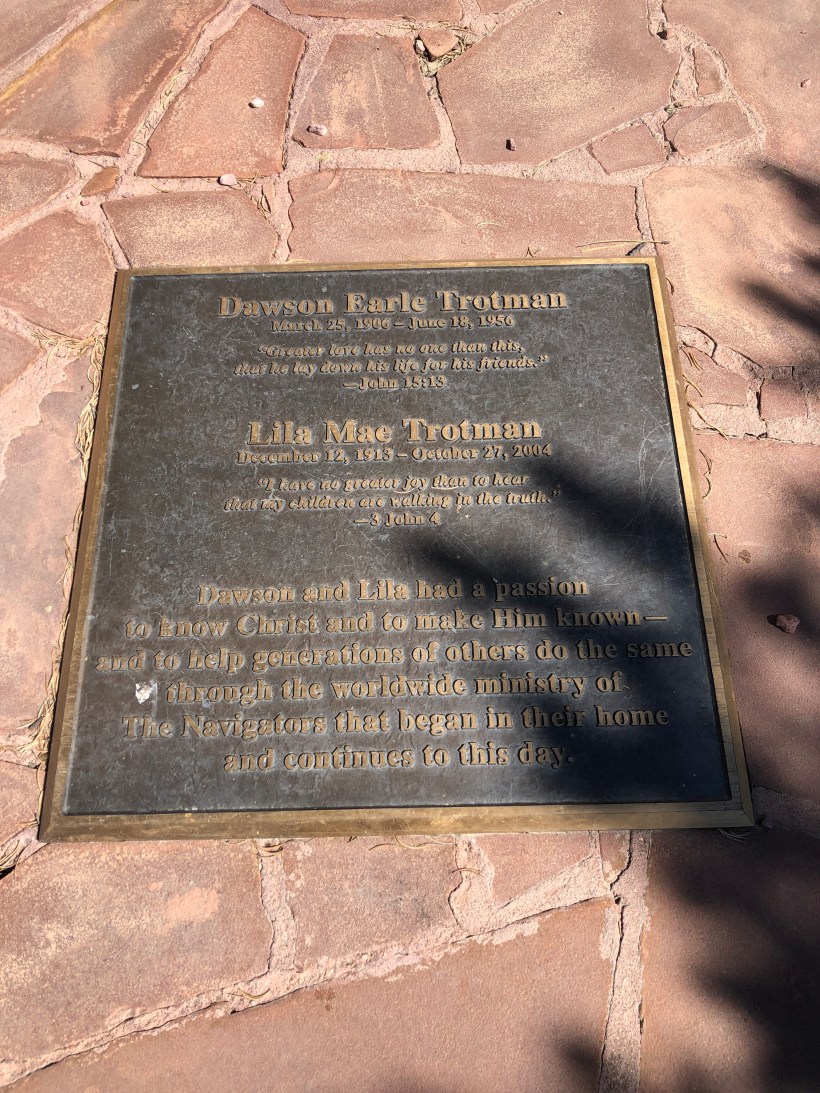
Work summoned me to Colorado Springs this week, and recognizing it as home to the international headquarters of the Navigators, I brought along a special book from my personal library. To understand why I chose this particular book to re-read on this trip, some background is in order. In the 60’s and 70’s my mother was church librarian and worked as part-time clerk for the Bible Book Shoppe in Port Arthur, so I grew up with a love of books and enjoyed an inside-track for receiving book treasures on every birthday, Christmas, and other various and sundry occasions. The first book Mom gave me after I made public God’s call to ministry was the biography of Dawson Trotman by Betty Lee Skinner. Daws was an evangelist and founder of the Navigators in 1933. My mother evidently felt that he was a fitting model for her soon-to-be preacher son, and she chose well. Trotman had been instrumental in developing a discipleship movement that continues to this day, and the Word of God shaped his life and ministry. Dawson and his wife Lila are buried together on a rocky hillside of the property called Glen Eyrie that serves as conference center of the Navigators. Just before heading to the airport for my flight back home, I drove to Glen Eyrie and gained permission to hike up to Dawson Trotman’s grave. Winded and slightly overwhelmed by the environs, I made it to the marker where I read the simple inscription: “Dawson and Lila Trotman had a passion to know Christ and to make Him known—and to help generations of others do the same.” Before descending to retrieve my car and head to the airport, I paused to thank God for their example and investment in eternity, and prayed that the same may be true of my own calling.

“But we have this treasure in clay jars, so that it may be made clear that this extraordinary power belongs to God and does not come from us.” 2 Corinthians 4:7 | NRSV

September 21: Abandoned

“I count all things but loss for the excellency of the knowledge of Christ Jesus, my Lord.” Philippians 3:8

If you would save others, you cannot save yourself. If you would bear much fruit, you must be buried in darkness and solitude. (Streams in the Desert)

No one ever sacrifices anything for Jesus. Whatever I relinquish on account of Christ is always an improvement; surrender lays the groundwork for growth. What we hold most dear threatens to ruin us; affection easily becomes idolatry. Self-preservation is anathema for disciples. Take a stab at self-crucifixion and you will see the Lord Jesus Christ high and lifted up instead of your own ego and ambition. It does not matter what people think or say about me; all that counts for eternity is that others see the beauty and glory of Christ that radiates from an abandoned heart.

Vision

“Where there is no vision, the people perish.” Proverbs 29 :18

Waiting upon God is necessary in order to see Him, to have a vision of Him. The time element in vision is essential. Our hearts are like a sensitive photographer’s plate; and in order to have God revealed there, we must sit at His feet a long time. The troubled surface of a lake will not reflect an object. Our lives must be quiet and restful if we would see God. There is power in the sight of some things to affect one’s life. A quiet sunset will bring peace to a troubled heart. Thus the vision of God always transforms human life.

Jacob saw God at Jabbok’s ford, and became Israel. The vision of God transformed Gideon from a coward into a valiant soldier. The vision of Christ changed Thomas from a doubting follower into a loyal, devout disciple.

But men have had visions of God since Bible times. William Carey saw God, and left his shoemaker’s bench and went to India. David Livingstone saw God, and left all to follow Him through the jungles of dark Africa. Scores and hundreds have had visions of God, and are today in the uttermost parts of the earth working for the speedy evangelization of the heathen. (Streams in the Desert)

The vision we need most is a right view of ourselves. Do yourself a favor just now and withdraw from the rat race long enough to be ruthfully honest. Be brutally frank—you have nothing to gain and everything to lose by playing games with memories. Ask, “Do I recall a previous moment when my heart leaned more toward Christ than it does right now?” If images and sensations come flooding back from an earlier time when you thrilled to Scripture and wanted nothing more than to bask in the presence of Christ and admonish others to do the same, do not balk but run back to that place. Refuse to pause at the altar of acceptability or convenience; race to brokenness. Fling yourself upon the memory and plead to God for dry bones to come back to life. This is His call and perfect will for your life—to abandon yourself to Christ in sweet communion and remain there, regardless of whatever distraction the enemy hurls at you.